Vehicle-Make-and-Model-Recognition-System
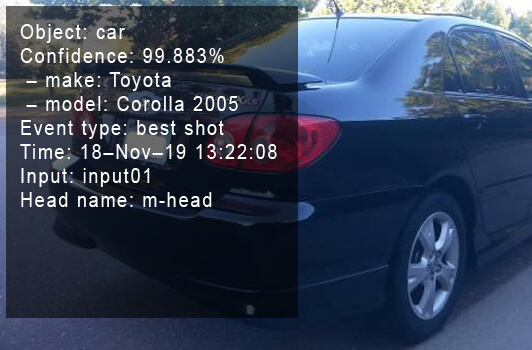
• Vehicle Make and Model Recognition is a Deep Learning based application indented for traffic maintenance. • Control and self control drive assistance etc,It would take the image of a vehicle from a picture or a video and indicates and classification the vehicle to its make and model. • The model is made of Convolutional Neural Network. • Using the transfer learning the model has achieved a top accuracy score of 93 Percentage.
Detection and recognition of automobiles is an essential role in the territory of traffic regulation and management. Commonly, to handle this task, broad databases and area specific features are used to better suit the data. In our undertaking, we build test and test classifiers on a self-build small dataset for the goal of classification and identification of cars into their make and model from their images from media devices. We try different things with various degrees of transfer learning to fit the models to our domain. We report and contrast these outcomes with that of standard models, and talk about the points of interest of this methodology.
Vehicle is a great invention in human history. Since then it has become an integral part of modern people’s life. The utilization of a colossal enormous number of vehicles mirrors the populace’s portability, closeness, monetary, etc, and the examination of vehicle conduct is extremely critical for urban turn of events and government dynamic.
Vehicle Make and Model Recognition (VMMR) is an important technology for the Intelligent Traffic System (ITS) that detects vehicles from images and videos and classifies vehicles into different types or brands. With the rapidly increase of vehicles, more and more sensors and computers are employed to monitor traffic conditions. Automatic vehicle classification is a useful technique for secure access, traffic observation applications, accidents prevention and terrorist activities review etc. Usual vehicle identification methods are based on Automatic License Plate Recognition. However, ALPR requires advanced image capturing equipment to generate highquality images and is sensitive to glare, dust and occlusion. ALPR frameworks are introduced in numerous countries for various purposes like law enforcement, electronic toll assortment, crime hindrance, traffic control, and so forth. ALPR systems distinguish a vehicle dependent on attached license plate. However, when two license plates are traded, the ALPR program can still identify both license plates but is ultimately unable to recognise the true identification. Licensing plates can be easily duplicated, occluded, and damaged. There are 3 examples in which it is almost difficult to identify the origin of the car is in Figure 1.1 Classification of vehicles could be an effective complement to the ALPR, which is capable to detecting and distinguishing vehicles with low-cost image/video capture equipment.
Source: saimanoj75/Vehicle-Make-and-Model-Recognition-System